Will More Apartments Fix Simi Valley’s Town Center Mall? Council Lets Housing Idea Move Forward—with Conditions
 Sylvie Belmond
(CLAIR | Simi Valley, CA) — The Simi Valley City Council has agreed to let a developer move forward with a proposal that could bring hundreds of homes to the Simi Valley Town Center—signaling the start of a lengthy review process that may reshape the future of the aging mall.
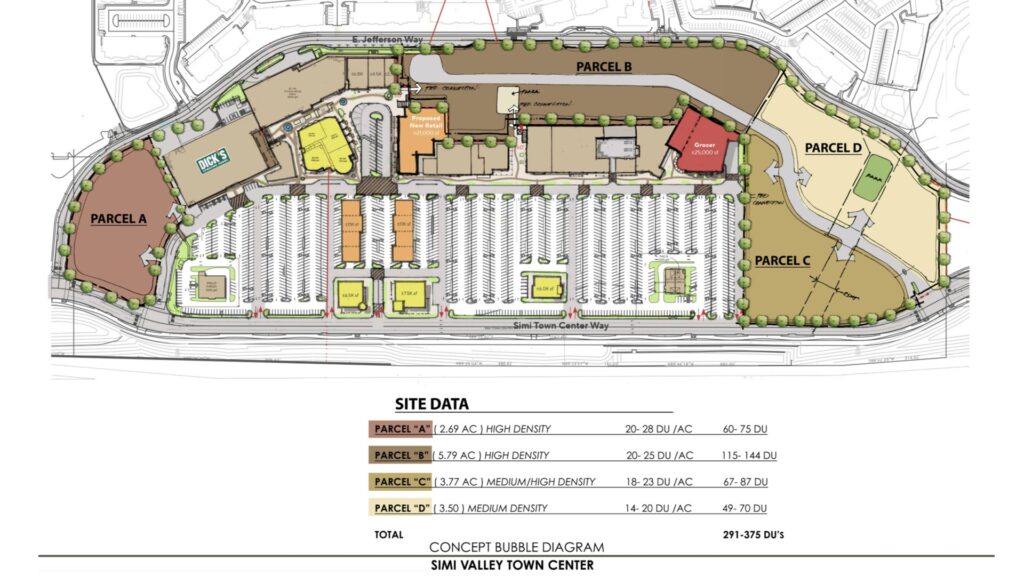
On May 19, the Council voted 4–1 to let developer SteelWave, LLC begin preparing a formal application to partially rezone the site from commercial to residential use. The area in question includes roughly 15.75 acres made up of long-vacant anchor buildings and surrounding parking lots.
City officials stressed the vote does not greenlight any construction. It merely allows the developer to enter the planning process, which will involve detailed environmental review, a development agreement and future public hearings. City Manager Samantha Argabrite explained that all project specifics—how many homes, what kind and when—will be negotiated in the months ahead.
If eventually approved, the proposal could bring between 291 and 375 new homes to the property, with the potential for up to 996 units under state density bonus laws. According to the city’s staff report, the redevelopment would demolish approximately 312,000 square feet of existing retail space—about 53% of the mall’s current 593,000 square feet. Just 42,000 square feet of new commercial construction would be added, resulting in a net loss of roughly 270,000 square feet, or 45% of the mall’s total retail footprint.
The area targeted for rezoning spans 15.75 acres—about a third of the 44.7-acre Mall District—and includes a mix of empty anchor buildings, underused parking lots and back-end service areas. Not all of that land is built on; much of it is currently vacant or unleased.
The project marks a shift from past policy. The Town Center had been intentionally excluded from Simi Valley’s 2021–2029 Housing Element in order to preserve it as a regional commercial hub. With only 4% of the city’s land zoned for commercial use, staff noted the site remains one of the few areas where the city can still shape future retail development and protect sales tax revenue.
Councilmember Elaine Litster, who cast the lone “no” vote, said the plan appears out of step with what residents want. She called the Town Center the city’s “crown jewel” and warned that once commercial space is rezoned for housing, it’s nearly impossible to get it back. She also raised concerns about hillside views and housing dominating the site’s footprint.
Councilmember Rocky Rhodes supported letting the process move forward but called for strict conditions. “My biggest fear is that we go forward with this and then find we’ve lost the ability to say no,” he said. He urged staff to pursue a development agreement with a clear unit cap and phased commercial improvements to avoid losing control under state housing mandates.
Councilmember Joseph D. Ayala recommended the city allow more flexibility by adding a mixed-use overlay zone and asked the developer to include a master plan for public amenities like a pool, open space and community areas.
Mayor Dee Dee Cavanaugh agreed to support the early application process but emphasized that housing should not be built ahead of retail upgrades. “We need to make sure the housing doesn’t go up and then nothing happens with the mall,” she said. She also requested to see a draft development agreement before any future vote.
Gregg Hall, managing director at SteelWave, said the Town Center was originally envisioned as a traditional mall two decades ago, but the retail landscape has changed dramatically due to the rise of e-commerce, the 2008 recession and the COVID-19 pandemic. He said that today, only about half the mall is leased and many of the larger spaces are no longer viable. The developer’s plan, he said, would preserve nearly all of the mall’s visible frontage, concentrate housing on underused portions at the rear, and create a more inviting destination for families and residents that blends retail, recreation and community space.
The development concept includes for-sale housing such as townhomes or duplexes, though no housing type or price range has been finalized. Hall said that for-sale options are likely more viable than rentals and that SteelWave wants to work with the city and community to shape the final design. “We have informed ideas,” he said, “but we want to hear from you to make this even better.”
Public comment during the hearing reflected mixed views.
Jeff DeJulius, general manager of the Town Center, voiced strong support for SteelWave’s approach and said the developer was the first in years to meaningfully engage with existing merchants. “This is the first time in a long time that someone has come forward and actually asked what the tenants need,” he said. DeJulius described the center as a hub for small and locally owned businesses and said revitalization could preserve that role. However, he also urged the city to be thoughtful about density. “There’s no reason to go high density at the mall,” he said.
Todd Huber, founder and director of the Skateboarding Hall of Fame and Museum, also spoke in support of the redevelopment but voiced concern that both his nonprofit and the neighboring VFW Military History Museum are located in buildings slated for demolition. Huber said the museums contribute to the city’s character and draw visitors from around the world. With skateboarding now an Olympic sport and the 2028 Games coming to Los Angeles, he noted that international attention is growing. He said he hopes SteelWave will work with them to find a new home within the revived Town Center rather than forcing them to relocate elsewhere.
Robert Ortiz, who operates a kickboxing and boxing venue at the mall, said his business has hosted major community events and welcomes world-class athletes and celebrities. He called the Town Center a blessing for small businesses like his, and said the gym offers young people an outlet for discipline and focus. Ortiz hopes the city and developer will allow tenants like his to stay and continue contributing to the community.
Other speakers supported the idea of redevelopment in principle, acknowledging the mall’s decline and the need for a new vision. But several raised concerns about building too many units, losing sales tax revenue, increasing traffic and the long-term loss of commercial zoning. Themes included the need for smart urban planning, transparency and protections for the city’s remaining retail base.
SteelWave now has one year to submit a formal application. The Council would then review a fully detailed proposal, which could only move forward with another public vote.
To view the full staff report and map of the proposal, visit:
https://simivalley.granicus.com/MetaViewer.php?view_id=5&event_id=1767&meta_id=227398
What do you think? Should part of the Town Center be turned into housing?
Share your thoughts in the comments.