Ken Burns at Reagan Library: ‘We Were Creating Citizens, Not Subjects’
 Sylvie Belmond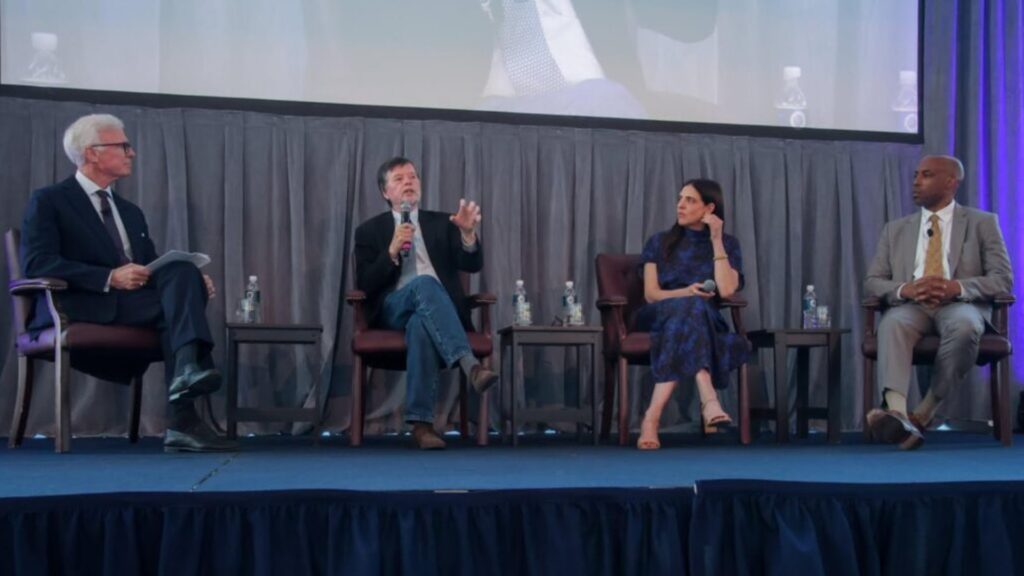
Filmmaker Calls American Revolution ‘Most Important Event Since the Birth of Christ’ in Powerful Reagan Library Talk
(CLAIR | Simi Valley, CA) — Filmmaker Ken Burns took the stage Friday, July 18, at the Reagan Library for an evening that felt both like a history lesson and a civic summons. Seated alongside co-director Sarah Botstein and Columbia University historian Christopher Brown, Burns offered a compelling look behind his upcoming PBS documentary, The American Revolution, while calling for a renewed national commitment to education, unity and democracy.
The event, hosted by the Reagan Foundation’s Center on Civility and Democracy, began with excerpts from the forthcoming six-part, 12-hour series, which premieres Nov. 16 on PBS. Visually stunning and emotionally layered, the clips introduced reenactments, voiceovers and 18th-century landscapes that set the tone for a discussion about storytelling, war and civic responsibility.
Reframing the Revolution
Burns described the American Revolution as “the most important event since the birth of Christ,” saying it has been “smothered with the barnacles of sentimentality and nostalgia.” Without photos, newsreels or firsthand accounts on film, he said, many Americans fail to grasp its violent, complicated and deeply human reality.
“We’ve accepted the violence of our Civil War and the 20th-century wars,” he said, “but somehow the Revolution feels less real to us—maybe because there are no photographs, only powdered wigs and breeches.”
The documentary presents the Revolution as more than a war for independence. It was also a war of conquest, a civil war and a global war. It impacted millions across North America and beyond—from Vermont’s Green Mountains to the Iberian Peninsula, and from South Carolina swamps to Indian Country. The film weaves together the perspectives of American and British leaders with those of “ordinary” men and women who lived, fought and suffered through the conflict.
To learn more about the series and its expansive scope, visit the official website at kenburns.com/films/the-american-revolution.
Distinguished Panelists
Burns was joined by two of his closest collaborators. Sarah Botstein, co-director of The American Revolution, has produced many of PBS’s most acclaimed documentaries, including Jazz, The War, Prohibition, The Vietnam War, College Behind Bars and Hemingway. Reflecting on the event’s setting, she noted, “I was thinking about what we might say tonight and about Reagan’s relationship to the Bicentennial… At the center of his presidency and I think kind of the message of this whole institution are three things: leadership, patriotism and where America sits in the world and foreign policy. And all of that really starts in 1776.”
Christopher Brown, a professor of history at Columbia University, served as a historical advisor to the series. His award-winning scholarship spans American history, British imperial history, slavery, abolition and resistance. He worked closely with the filmmakers to ensure the accuracy and nuance of a story that spans both continents and ideologies.
Brown emphasized the youth of the Revolutionary leaders. “One of the reasons why they had that kind of optimism was because they were thinking about the world that they wanted to live in and make for the two or three decades of the life that they had in front of them,” he said.
The script was written by longtime collaborator Geoffrey C. Ward, who Burns credited with crafting the narrative backbone. “Jeff Ward… wrote this extraordinary script,” Burns said, also recognizing the team’s other co-director David Schmidt, who grew up in Williamsburg, Virginia, and helped source the first-person voices that make the film a “bottom-up” story.
History With Heart
Burns said his goal was to tell both top-down and bottom-up stories. Alongside George Washington and Thomas Jefferson, viewers will meet Native leaders, enslaved people, children and loyalists whose voices are often missing from the national memory.
“This was a civil war,” Burns said. “Neighbor against neighbor. Father against son. There’s a loyalist we follow named John Peters who, during a battle, is bayonetted by his boyhood friend. That’s the kind of heartbreak we need to remember.”
He also called attention to the war’s devastating human cost across racial and cultural lines. “The 3 million Americans, including 500,000 enslaved or free Black people, are spread out, and their suffering is proportional to our Civil War,” he said. He further highlighted the sovereignty of Native nations, explaining that they were treated not as background actors but as major powers. “We treat them not as ‘them’ but as independent nations with as much sort of prominence and force as, say, Virginia is or maybe the Netherlands are,” Burns said.
He emphasized Washington’s unique restraint. “He could have been king,” Burns said. “Instead, he stepped down—twice. That’s what makes him the greatest character of the age.”
Throughout the evening, the theme of civility echoed. Burns urged Americans to resist binary thinking and ideological rigidity. “Human existence is the tolerating of contradictions,” he said. “You can’t have friends or children or a democracy without that.”
He added, “Put the ‘us’ back in the U.S.”
PBS Funding Cuts: “Shortsighted”
Earlier that day, Burns spoke with PBS NewsHour from his hotel room in Simi Valley, responding to Congress’s decision on July 17 to revoke $1 billion in previously approved funding for the Corporation for Public Broadcasting. The CPB distributes funds to PBS and NPR stations nationwide.
“I think we’re all in a bit of a state of shock and also sort of reeling at the shortsightedness of it all,” Burns told PBS. “This is such an American institution, trusted by people across political divides, geographic divides, age groups… and what’s so shortsighted about it, I think, is that this affects mostly rural communities or the hardest-hit.”
Full story: PBS NewsHour
Burns said about 20 percent of his documentaries’ funding typically comes from CPB. Linking the issue to the themes of his new film, he noted that the pursuit of happiness—as intended by the founders—meant not consumerism, but education.
“We were creating citizens, not subjects,” he said. “The founders believed that education had to be part of it, and it had to be continuing education. Otherwise, you couldn’t be virtuous.”
Preserving the Poetry of the Past
Fred Ryan, director of the Center on Civility and Democracy, praised the film’s ability to connect viewers to the 18th century through letters, diaries and voice acting. “Each time I watch and listen to it, I sometimes just close my eyes just for the language, the poetry of the period,” he said.
“There really actually is a capacity to transport back to the 18th century even without all of the tools that we’re used to having,” Ryan added.
Looking Ahead to America250
Toward the end of the evening, Ryan asked what could be done—through this film or otherwise—to ensure the United States’ 250th anniversary in 2026 becomes a moment for national renewal. Burns responded that while the project began long before America250 was part of the national conversation, the timing now feels providential.
“We never thought of 250,” he said, noting that development began when President Obama still had 13 months left in office. “But a few years in, we realized—oh my goodness—if we play our cards right, we may be able… maybe not to reach the 250th of Lexington and Concord… but maybe we’ll be in the fall.”
He said the team hopes the documentary will inspire Americans to approach the semiquincentennial with greater depth and humility, not just pageantry.
“We’re really, really happy that we might play a part in having a conversation that restores to us the sense of the possibilities of us cohering,” Burns said. He quoted Kanasa, a Native voice featured in the film, who advised, “Never fall out with one another.”
He ended with a reminder of what was once unthinkable: that a ragtag group of colonists could defeat the most powerful empire in the world. “The odds were zero,” he said. “And our film is how that zero went to 100 percent.”
Lessons for the Next Generation
Asked what lessons the founders’ generation might offer young people today, Brown said it begins with remembering how young those leaders were themselves. “So many of the key figures were at formative stages of their lives,” he said. “A lot of the political change and idealism—people who do the fighting, who go to war with all of that energy and belief in each other—those are people in their late teens, early 20s.”
Watch the Full Conversation
To hear the full discussion—including reflections on maps, moral conflict and the power of storytelling—watch the archived livestream from the Reagan Library: View the video