Simi Valley Schools Stand at the Edge of an AI Revolution — Here’s What’s Coming Next
 Daniel Jordan
Explore how artificial intelligence in schools could redefine learning in Simi Valley — and why embracing this technology now could give Simi students a lasting advantage.
(CLAIR | Simi Valley, CA) — Something remarkable is happening in classrooms across the world — and Simi Valley is perfectly positioned to catch the wave. Artificial intelligence, once a distant idea confined to science fiction, is beginning to reshape how children learn, how teachers teach, and how schools operate.
Simi Valley schools have not introduced AI into classrooms in a significant way. But that could change. District leaders are now developing a formal framework to guide responsible AI use across the school system, marking the start of a new era in local education.
That presents both a challenge and an opportunity: a challenge to keep pace with a rapidly changing educational landscape, and a chance to lead the way in Ventura County by adopting technology that could dramatically improve how students learn.
A Glimpse Into the Classroom of the Future
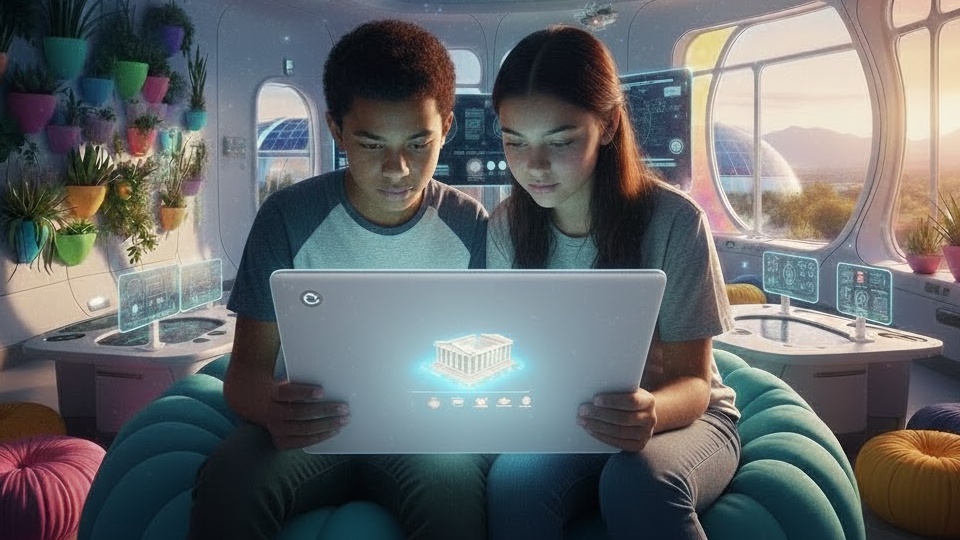
In October 2025, Google Research released a groundbreaking paper titled “Towards an AI-Augmented Textbook.” It introduces Learn Your Way, a new AI-powered learning system designed to make education as personal as a fingerprint.
The idea is simple but revolutionary: what if every child’s textbook could adapt — instantly — to their reading level, learning pace, and personal interests?
That’s exactly what Learn Your Way does. Instead of reading the same material as everyone else, each student experiences content tailored specifically for them. A student who loves baseball learns physics through the curve of a pitch. A future artist explores motion through brushstrokes. A budding musician studies sound waves through guitar strings. Every child learns differently — and for the first time, a textbook can reflect that.
How the Technology Works
Learn Your Way is powered by Gemini 2.5 Pro, Google’s most advanced education-focused AI model. The system personalizes lessons in two main ways:
- By Level: It adjusts the language and complexity to each student’s grade and reading comprehension level.
- By Interest: It integrates real-world examples based on what each student cares about most.
Then, the AI creates a suite of learning modes to bring those lessons to life:
- Immersive Text Mode: An interactive digital textbook with visuals, short quizzes, and links to related concepts.
- Narrated Slides: AI-generated presentations that mimic a teacher’s guided explanation.
- Audio Lessons: Conversational lessons between a virtual teacher and student, modeling curiosity and clarification.
- Mind Maps: Visual diagrams showing how ideas connect, helping visual learners grasp the bigger picture.
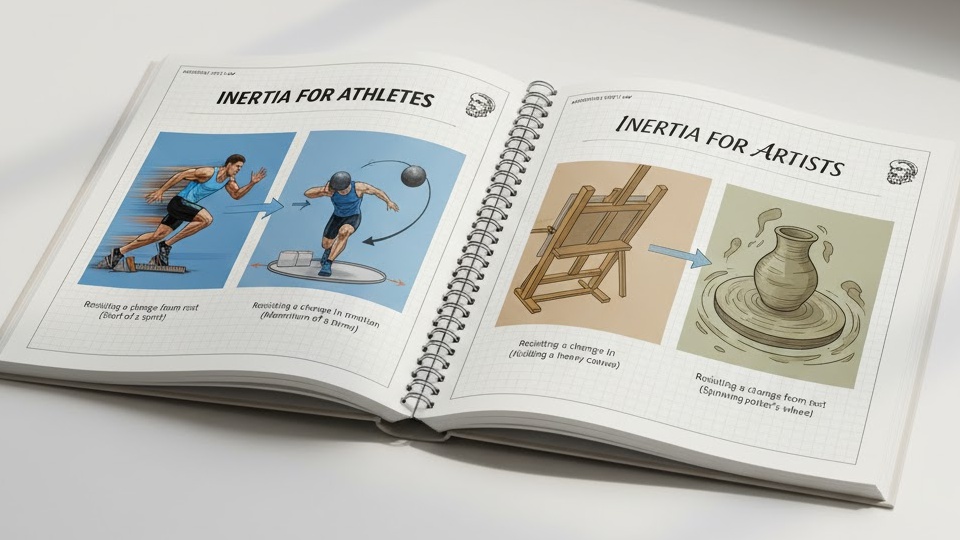
Students can move between formats freely — reading one moment, listening the next, or exploring a concept visually. For struggling readers, that flexibility can mean the difference between confusion and clarity. For advanced students, it can mean moving ahead at their own pace without losing interest.
Proof That It Works
In a pilot study of 60 high school students, Google researchers compare traditional digital textbooks with the Learn Your Way system. The students using AI-personalized material score 9 points higher immediately after the lesson and 11 points higher several days later.
These aren’t small gains — they reflect real improvements in understanding and retention. Students also say they feel more confident, less anxious, and more motivated to learn. Teachers reviewing the system praise its accuracy and adaptability, noting that it could save hours of preparation time by automatically adjusting material for mixed-level classrooms. If a program like this is introduced in Simi Valley, it could dramatically improve equity and engagement — giving every student a customized path to success.
What This Could Mean for Simi Valley
Right now, most Simi Valley classrooms rely on traditional lesson plans and digital textbooks that treat every student the same. AI can change that.
Imagine a classroom where lessons adapt automatically to each student’s abilities and interests. Teachers track real-time progress, seeing instantly who needs extra help or who is ready to move ahead. Students explore topics through the formats they enjoy most — reading, listening, or interacting — all while staying aligned to the California curriculum. For families, that means fewer homework frustrations, stronger academic confidence, and a learning environment that finally fits each child’s needs.
AI Beyond the Classroom: Personalized Tutoring and Support
The potential doesn’t end at the final bell. AI-powered tools now act as 24/7 tutors, offering step-by-step help on assignments and explanations for complex subjects. Language students practice conversation with AI speech partners, while writers get instant feedback on structure and clarity. High schoolers preparing for college entrance exams or job interviews even use AI to build study plans, practice essays, and refine personal statements. The result is a continuous learning environment — one where curiosity never has to wait for a scheduled class.
The New Literacy: Learning to Learn With AI
With opportunity, however, comes a new challenge. Experts now warn of an emerging AI literacy divide — one that separates students who know how to use AI tools from those who don’t. Students fluent in AI grow up able to ask better questions, analyze information more critically, and apply knowledge in new ways. They enter the workforce prepared for a world where digital intelligence is everywhere. Those without AI experience may find themselves unprepared, not for lack of intelligence, but for lack of exposure.
Many researchers and educators agree that AI literacy will become as fundamental as reading and writing and emphasize that students should learn to use it responsibly, not fear it.
A Head Start: CLAIR’s Legacy Story Writing Class
While Simi Valley schools have not yet adopted AI-driven learning, one local program has already explored what was possible. CLAIR recently launched the Legacy Story Writing Class at the Simi Valley Senior Center — a six-week pilot designed to test how AI could support real-world learning.

In this free class, participants used a custom-trained AI writing assistant to help them turn their memories into personal books. The AI guided them through prompts, organization, and editing, helping shape their stories into ten meaningful chapters.
Though designed for seniors, the class served as an early research test of how AI could enhance learning for people of any age. It demonstrated that even those with limited computer experience could use AI successfully to express themselves, develop new skills, and build confidence.
The project blended human creativity with intelligent technology — a working example of how AI could guide, rather than replace, the learning process. It reflected the same principles that could one day transform Simi Valley classrooms, making education more personalized, accessible, and engaging for every student.
As one of the instructors explained, “Our goal was to explore what happens when people who don’t see themselves as writers are given the tools to share their stories. The outcome was extraordinary — they learned not only to use new technology, but to give written form to memories and emotions long left unspoken.”
Why Simi Valley Should Act Now
While larger districts in California are beginning to explore AI-assisted education, Simi Valley now has the chance to take a more community-centered approach. In fact, the Simi Valley Unified School District has already begun taking early steps toward responsible AI integration.
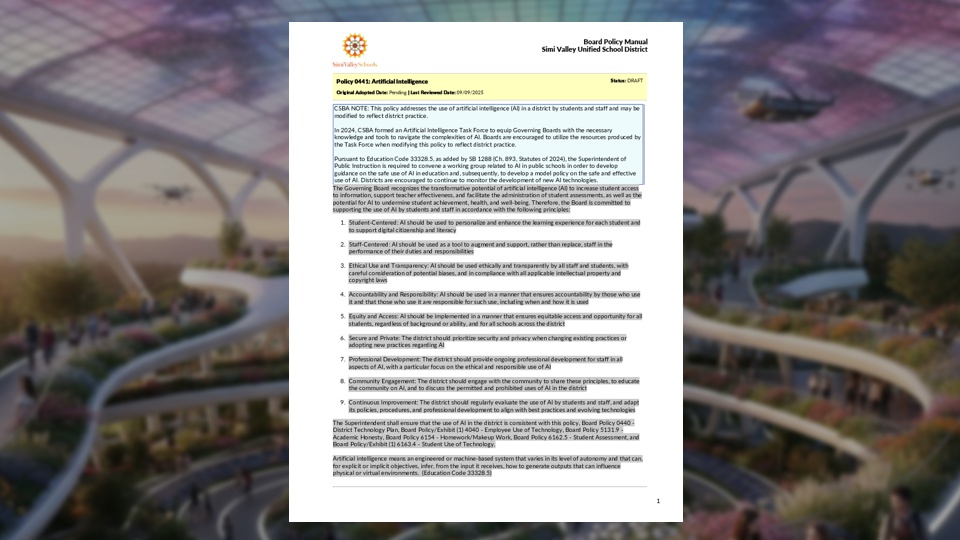
In September 2025, the district’s Board of Education introduced Board Policy 0441 – Artificial Intelligence, a framework that defines how AI should be used by students and staff. The draft policy emphasizes ethical use, equity, and transparency — ensuring that AI supports learning rather than replacing human guidance. It also calls for professional development for teachers, community engagement, and strong privacy protections for student data. While the policy is still in its early stages, it signals that Simi Valley is preparing to bring AI into classrooms safely and thoughtfully.
Local schools can also partner with organizations like CLAIR, collaborate with developers, and pilot AI programs on a small scale before expanding. City leaders can host public workshops to teach families about responsible AI use, ensuring parents understand both the benefits and boundaries of the technology. By starting now, Simi Valley can become a regional leader in safe, transparent, and equitable AI integration, protecting students’ privacy while preparing them for the future. Waiting too long could leave our children behind.
Balancing Innovation With Caution
AI education is not without risk. Automated systems can sometimes generate inaccurate information or show bias. Overreliance can lead students to depend on the tool rather than develop independent thinking. That’s why successful adoption requires teacher oversight, strong ethics, and community involvement. AI should never replace educators — it should amplify their ability to reach every student.
The district’s new policy also highlights the importance of professional development, ensuring teachers are trained to use AI responsibly and effectively. When guided properly, AI gives teachers more time for mentorship, collaboration, and the human connections that technology will never replace.
Imagining a Smarter, Fairer Future
Imagine this: A Simi Valley high schooler logs into an AI-powered science textbook. The lesson adjusts to their reading level and ties examples to local landmarks like parks or nearby mountains. The platform quizzes them, offers feedback, and creates a personalized study guide. Meanwhile, their teacher reviews real-time dashboards that show who’s mastering key ideas and who needs extra help. Parents receive summaries that make it easier to stay involved. That vision is within reach — the technology already exists. What’s missing is the decision to bring it to our community.

The Call to Lead
Artificial intelligence isn’t just transforming how people work — it’s transforming how they learn to work. If Simi Valley wants its students to thrive in the coming decades, it must begin preparing them now. That means training teachers, ensuring equal access, and helping students learn how to use AI responsibly and creatively. This is more than a technical upgrade. It’s a chance to reimagine what learning can be — to make it more personal, engaging, and equitable than ever before.
The Bottom Line
Simi Valley stands at a crossroads. The city can watch as other communities embrace AI in education — or it can take bold steps to lead. By exploring systems like Google’s Learn Your Way and learning from local experiments such as CLAIR’s Legacy Story Writing Class, Simi Valley can ensure that every child has access to the tools that define tomorrow.
The research is clear. The opportunity is real. The only question that remains is: Will we be ready to bring it home?