They Promised a Simple Renovation. What They Built Instead Sparked Outrage
 Daniel Jordan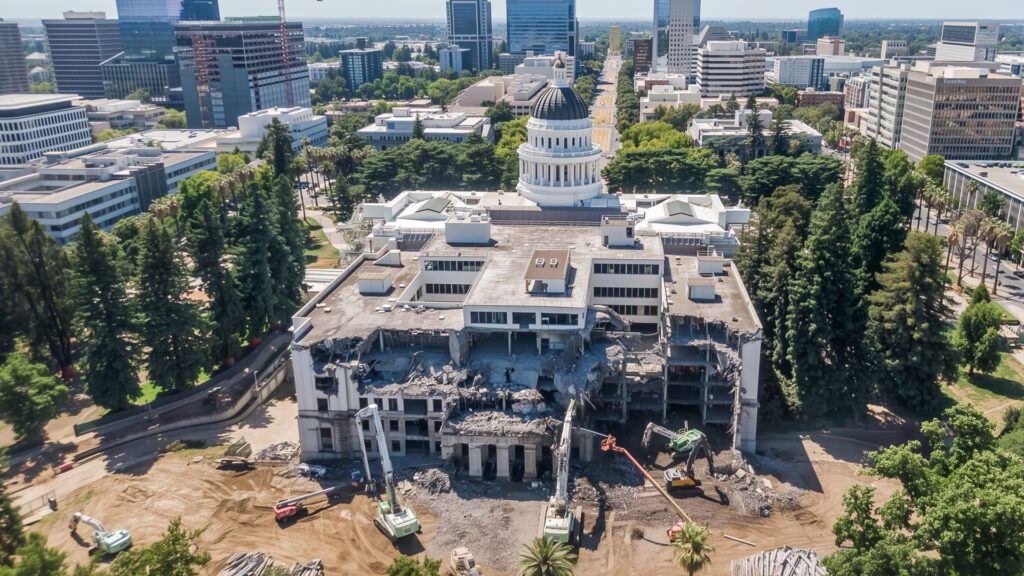
(CLAIR | Ventura County, CA) — Under the leadership of Governor Gavin Newsom and the California State Legislature, what began in 2018 as a modernization project for the aging East Annex of California’s State Capitol has grown into one of the most expensive and controversial public works efforts in state history. The price tag now exceeds $1.1 billion, and taxpayers — not private donors — are footing the entire bill. What was once presented as a routine accessibility and safety upgrade has become a case study in secrecy, legislative maneuvering, and questions about how California manages its own house.
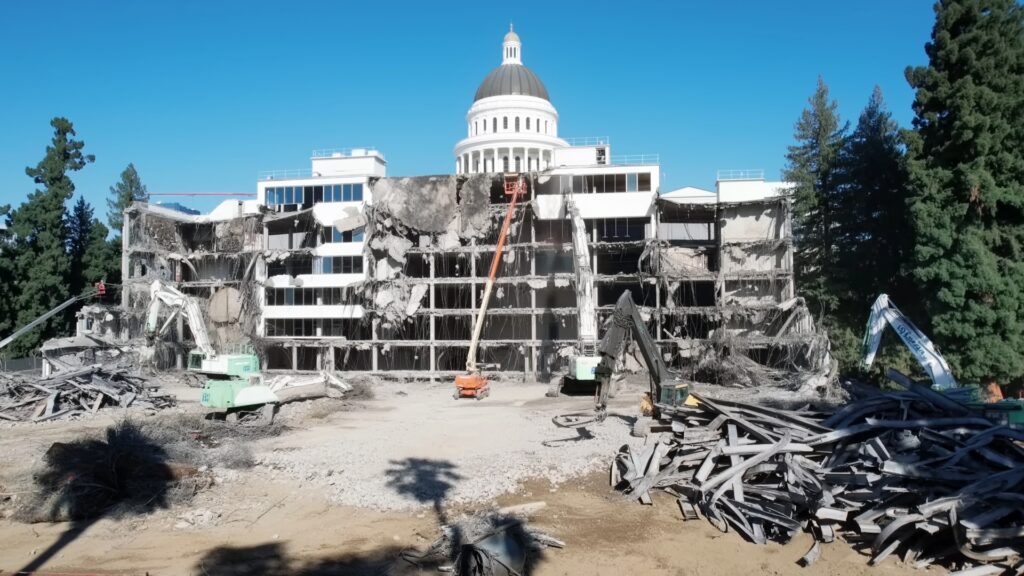
A Project Meant to Modernize the Capitol
The Capitol annex, completed in 1952, once housed the governor’s office, 115 of the state’s 120 lawmakers, and hundreds of staff members. Lawmakers approved a plan in 2018 to rebuild it, citing outdated plumbing, poor ventilation, and limited wheelchair accessibility.
Former Assemblymember Ken Cooley, one of the project’s early supporters, explained the intent during the 2019 groundbreaking of the temporary “swing space,” built to hold lawmakers during construction. “The seat of government is a people’s house,” Cooley said at the event, according to a report by FOX26 Fresno. “That building built in 1952 is not welcoming to those Californians blessed today to get mobility through wheelchairs that are motorized. The bathrooms are unappealing. There’s so many ways in which that building is not welcoming, which is the original spirit of the building.”
At that time, the project’s estimated cost was between $500 million and $750 million. Lawmakers promised transparency and adherence to historic preservation rules.
Seven years later, the promises have fallen apart.
Costs Double, Oversight Fades
By mid-2025, costs had ballooned to $1.1 billion, according to multiple reports. The money comes directly from the state’s general fund, meaning taxpayers are paying for every dollar of the project.
When asked why the costs rose so sharply, officials cited construction inflation, design changes, and litigation delays. Critics, however, point to a pattern of poor oversight and secrecy.
In a 2021 legislative hearing, former Department of Finance official Bruce Lee recalled reviewing the project and questioning its fiscal logic. “When I had proposals that would come to me that would be hundreds of millions of dollars or greater, I’d ask two questions,” Lee said, as reported by FOX26. “One was, does this make sense, and secondly, where is the money coming from? I’m afraid in the analysis of the Capitol Annex Project that we’re failing at both those counts.”
Assembly Republican Leader James Gallagher expressed similar concerns in a written statement provided to reporters. “This project is not about serving Californians,” Gallagher said. “It is about serving themselves. And taxpayers are the ones stuck with the bill. Californians deserve answers, not more excuses.”
Design Sparks Historic and Public Backlash
The new annex will be wider, taller, and longer than the original 1952 structure. It will also feature a glass exterior, sharply contrasting with the 19th-century plaster of the historic Capitol dome. Preservationists argue that the new design violates the Secretary of the Interior’s guidelines for historic structures.
Advocates also worry about Capitol Park, home to hundreds of mature trees and public lawns. Construction has removed parts of the park and threatened the West Steps and plaza, the traditional site for rallies and public gatherings. Despite verbal assurances from state officials that the space will remain open, there are no written guarantees.
“Those steps are the literal and symbolic heart of public expression in California,” said Richard Cowan, the former chairperson of the Historic State Capitol Commission, in a CalMatters commentary published September 5, 2025. “To dig them up without public consent violates the spirit of the Capitol itself.”
Environmental Review Bypassed
The project faced a major lawsuit in 2021 from Save Our Capitol, a preservation group arguing that the state’s environmental review was inadequate. The lawsuit briefly halted construction until the Legislature passed a bill exempting the annex from the California Environmental Quality Act (CEQA).
That exemption, signed by Governor Gavin Newsom, cleared the way for work to continue. Preservationists called it a dangerous precedent. “If lawmakers can exempt themselves from the same laws that apply to everyone else, what does that say about accountability?” Cowan wrote in his CalMatters column.
Governor Newsom’s Role
Governor Gavin Newsom has played a quiet but pivotal role in the project’s fate. While he did not initiate the annex plan, every key funding and exemption bill has required his signature. His Department of General Services (DGS) manages the project, meaning the agency reports directly to his administration.
Despite repeated questions from journalists and watchdog groups, Newsom’s office has declined to release detailed cost breakdowns or comment on the use of nondisclosure agreements, according to KCRA News and CalMatters. The governor has also not called for an independent audit, something advocates say could rebuild public trust.
As the state’s chief executive, Newsom has the power to order such a review through the State Auditor. Critics argue his reluctance to do so suggests a preference to avoid conflict with legislative leaders who support the project.
The Legislature’s Role: Quiet Maneuvering
While the governor’s office has been publicly reserved, the California Legislature has been actively steering the annex project behind closed doors.
In June 2022, lawmakers quietly inserted provisions into a budget trailer bill (SB 189) that shifted control of the project away from the Department of General Services and into the hands of the Joint Rules Committee, which is run by legislative leaders. The same bill exempted the annex from normal historic preservation consultation.
Then, in 2024 and 2025, additional trailer bills extended spending and made further adjustments — all without public hearings or detailed debate.
Trailer bills, often hundreds of pages long, are passed alongside the budget and allow major policy changes to advance with minimal public notice. Critics, including Cowan in his CalMatters commentary, have called this a “backdoor tactic” that undermines accountability.
“Each time the Legislature changes the rules, public oversight shrinks,” Cowan wrote. “These are the same lawmakers who will occupy the building once it’s done. That’s a clear conflict of interest.”
Secrecy and Nondisclosure Agreements
The annex project has operated under unusual secrecy for a public endeavor. Multiple sources confirm that consultants, architects, and even some lawmakers were required to sign nondisclosure agreements (NDAs).
Assemblymember Joe Patterson, a Republican from Rocklin, introduced Assembly Bill 1370, which would ban NDAs in public business dealings. “If we’re spending public money, there should be public transparency,” Patterson told CalMatters in an interview earlier this year.
To date, the state has not released the full contract list or construction cost ledger for the project.
New Construction Rules Add Complexity
Adding to the cost and uncertainty are new Cal/OSHA regulations, effective July 1, 2025. The rules lower the required height for fall protection from 15 feet to 6 feet and apply to nearly all framing and roofing work, including public projects like the Capitol annex.
Construction industry leaders, including representatives of the Western States Regional Council of Carpenters, said in a March 2025 petition to Cal/OSHA that compliance inside multi-story buildings “is often infeasible and can create a greater hazard.” Despite their concerns, the Cal/OSHA Standards Board rejected a delay request in September 2025 but agreed to create an advisory committee to consider clarifications.
The new rule underscores a wider tension: as safety and environmental standards rise, so do the costs and technical demands of public works projects.
Public Reaction and Growing Distrust
For many Californians, the Capitol annex project has become a symbol of government excess. On social media and in public meetings, residents ask simple questions:
- Why did the cost double?
- Who is overseeing the spending?
- Why are NDAs being used in a public project?
- And will the public still have access to the Capitol steps once it’s done?
Even some lawmakers have begun expressing frustration. In the 2025 session, a bipartisan group called for a full independent audit by the State Auditor’s Office. As of October, the governor has not publicly supported that request.
What This Means for Other Projects
The Capitol annex is more than a construction project. It’s a lesson in how government decisions ripple across every community in the state. In Simi Valley, Ventura County, and other cities planning infrastructure work — from school renovations to transit projects — the annex story is a warning:
- Transparent budgeting must be nonnegotiable.
- Public participation should not be bypassed through exemptions.
- Regulatory changes like new safety rules must be anticipated early.
- Independent audits should be standard practice, not a crisis response.
If California’s leaders can quietly double the cost of their own building while limiting access to records and public spaces, taxpayers are right to ask what might happen with less-visible projects elsewhere.
A Test of Accountability
Governor Newsom and the Legislature now share responsibility for restoring trust. Both have the power to open the books, order a full audit, and ensure that the Capitol — the people’s house — remains a place the public can see, enter, and believe in.
As Richard Cowan concluded in his CalMatters essay: “It’s not too late to change course. But doing so will take more than statements. It will take honesty.”
Estimated completion date: Still unknown.
Estimated cost: $1.1 billion and climbing.
Public confidence: Falling fast.
The future of California’s Capitol may depend less on concrete and glass — and more on whether its leaders choose sunlight over secrecy.