Simi Valley Once Had a Bavarian Castle — Then It Disappeared Without a Trace
 Daniel Jordan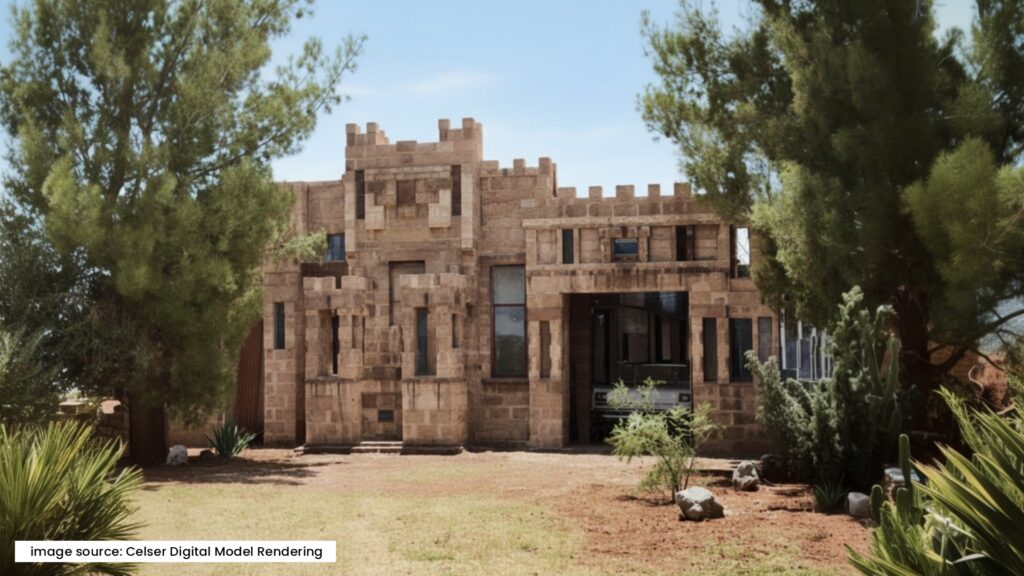
No Records. No Ruins. Just Rumors: The Disappearance of Ulmer’s Castle
(CLAIR | Simi Valley, CA) — Every town has its legends — stories told quietly, repeated with doubt, then half-forgotten. Simi Valley has one that refuses to fade.
Once, there was a castle here.
Not a mansion dressed up with turrets, not a novelty built for show — but a real Bavarian-style stone fortress. Its walls were thick, its beams hand-cut. It was the work of a man who had fled a world at war and carried his memories, and perhaps his ghosts, across an ocean.
For nearly four decades, this unlikely landmark stood along Cochran Street, the main road that would one day cut through the center of Simi Valley. People drove past it daily — a quiet monument rising above a rural town in transition. It was photographed, written about, listed for sale more than once. Families lived there. Children were born inside its walls. And then, one day, it was gone.
No record of a sale.
No demolition notice.
Not a single mention in Ventura County’s building archives or heritage files.
The castle simply disappeared.
Today, its address — 4986 Cochran Street — shows nothing listed at that location. It looks like any other suburban parcel. Asphalt, sidewalks, trees that know nothing of the stones buried beneath them. The land has been graded, built upon, and folded into the smooth geometry of the modern city. But if you open Google Maps and zoom in close, a whisper appears:
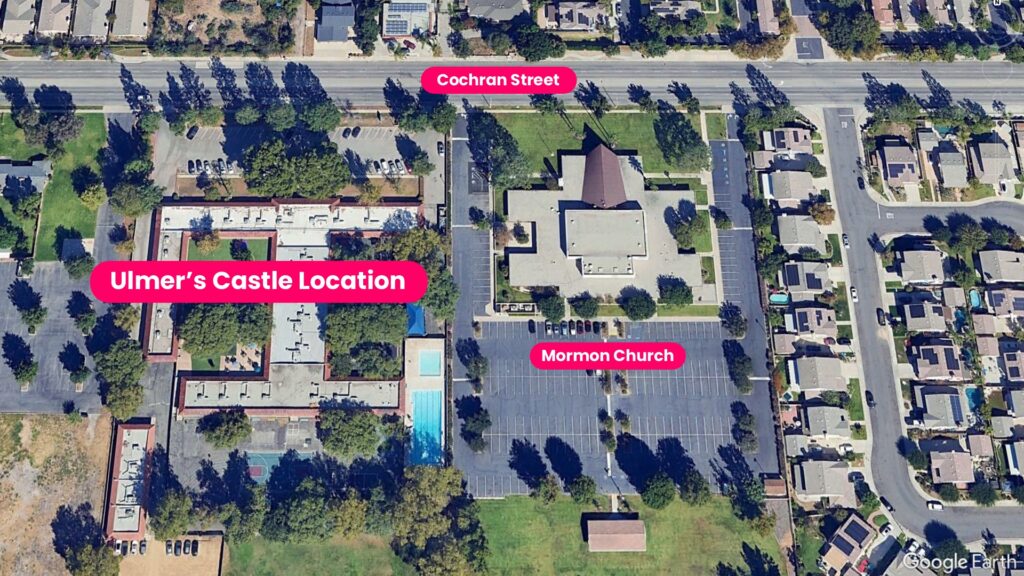
“Historic Landmark — Site of Ulmer’s Castle.”
That label is not official. It isn’t recognized by the Ventura County Cultural Heritage Board, which keeps a meticulous list of the region’s landmarks. No mention of any “castle” appears in those public records. Yet the name persists, passed from one curious local to another, reappearing online like a rumor that refuses to die.
Who built it? What happened to it? Why was it erased so completely that it survives now only as a ghost on a digital map?
The answers begin, and perhaps end, with a man named Lt. John Tury Ulmer — a former Prussian officer who tried to recreate his homeland from memory, one stone at a time.
The Man Who Built It
Ulmer’s story reads like a novel that history misplaced. Born in Munich, he served as a Prussian officer during World War I. When the war ended, he fled Germany under uncertain circumstances — “escaping intelligence officers,” as a 1970 Simi Valley Enterprise article later put it. He and his wife, Mary, sailed to Argentina, a haven for many displaced Europeans in the 1920s.
There, Ulmer worked as a cabinetmaker, saving what little he could. By 1923, the couple had crossed again to New York. A few years later, while visiting California, a real estate salesman drove them north from Los Angeles into a valley of orchards and ranchland. The paper quoted them saying they “fell in love with the area.” They bought five acres of open land and decided to stay.
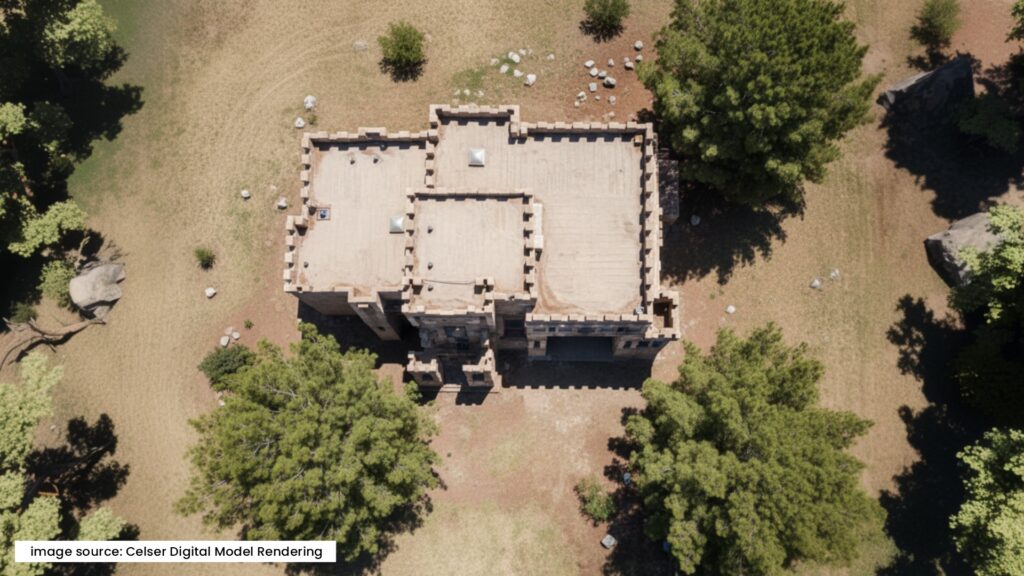
In 1939, Ulmer began his life’s work: building a quarter-scale replica of a Bavarian castle he loved back home. There were no crews, no blueprints — just stone, wood, and memory. The Enterprise would later write that he built it “stone by stone and beam by beam,” using his own hands to recreate the architecture of his childhood.
For decades, the Ulmers lived quietly in their handmade fortress. The trees Ulmer planted in the 1930s grew tall enough to frame the structure in shade. Their home became part of the valley’s landscape — strange, beautiful, and enduring.
The Castle in the News
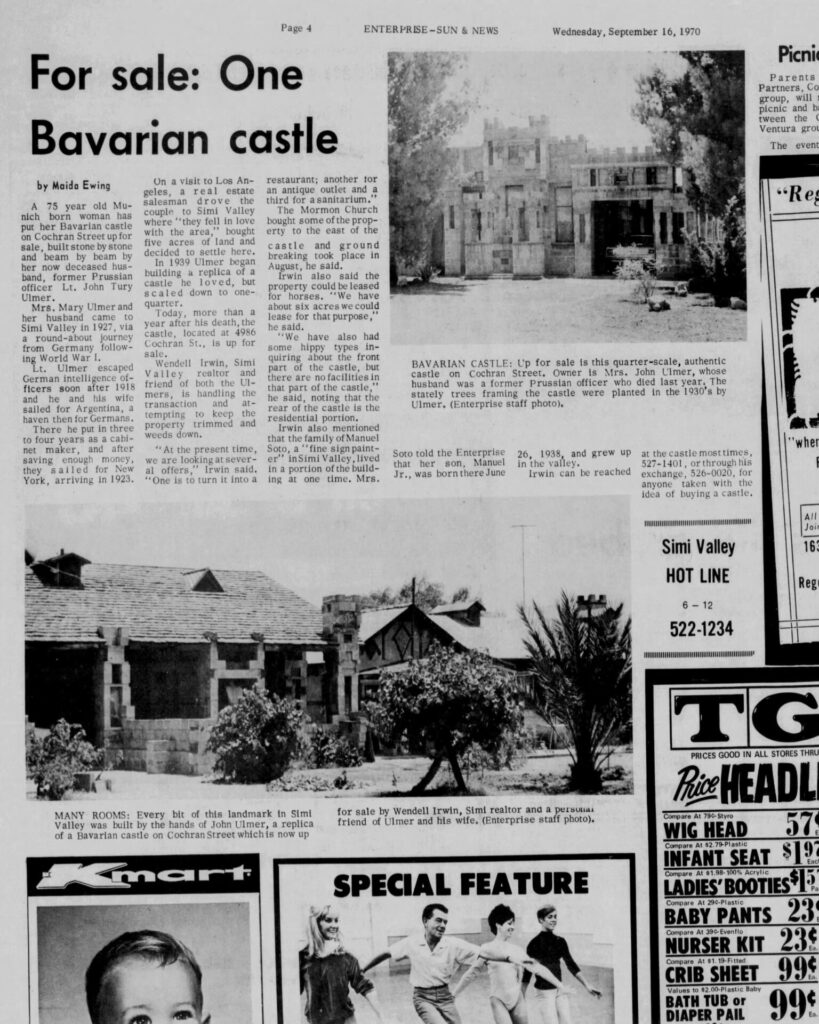
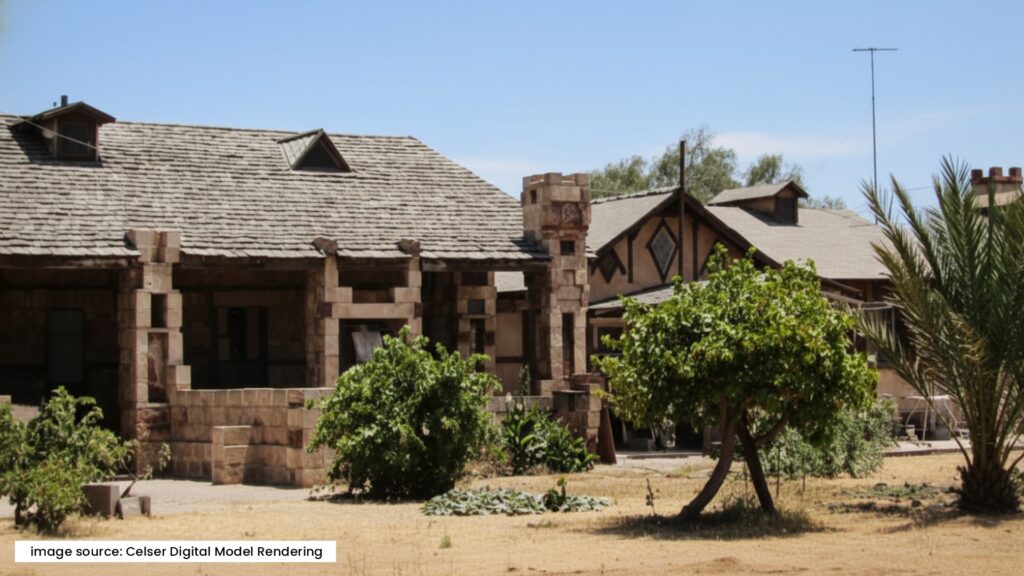
When Lt. Ulmer died around 1969, Mary, then seventy-five, decided to sell the property. The Simi Valley Enterprise story of September 16, 1970, headlined “For Sale: One Bavarian Castle,” brought the home to public attention. Reporter Maida Ewing described it as an “authentic Bavarian castle,” standing on Cochran Street, “built stone by stone and beam by beam by her now-deceased husband.”
The article’s black-and-white photographs — later colorized and shown above — remain the only known images of the castle.
Realtor Wendell Irwin, a friend of the Ulmers, was overseeing the sale. He told the Enterprise that he was maintaining the property himself while several offers were being considered. “One is to turn it into a restaurant,” he said. “Another for an antique outlet, and a third for a sanitarium.”
Irwin added that part of the land to the east had already been sold to the Mormon Church, which broke ground that August on its new chapel — the same one that still stands today. He also noted that the property had drawn attention from “some hippy types,” who were interested in the building’s front section. “There are no facilities in that part of the castle,” he explained. “The rear of the castle is the residential portion.”
One local family, the Sotos, had lived there years earlier. “Her son, Manuel Jr., was born there June 26, 1938,” the article reported.
It was, by all accounts, a home full of stories — and one that still stood proudly in 1970.
The Listings That Followed
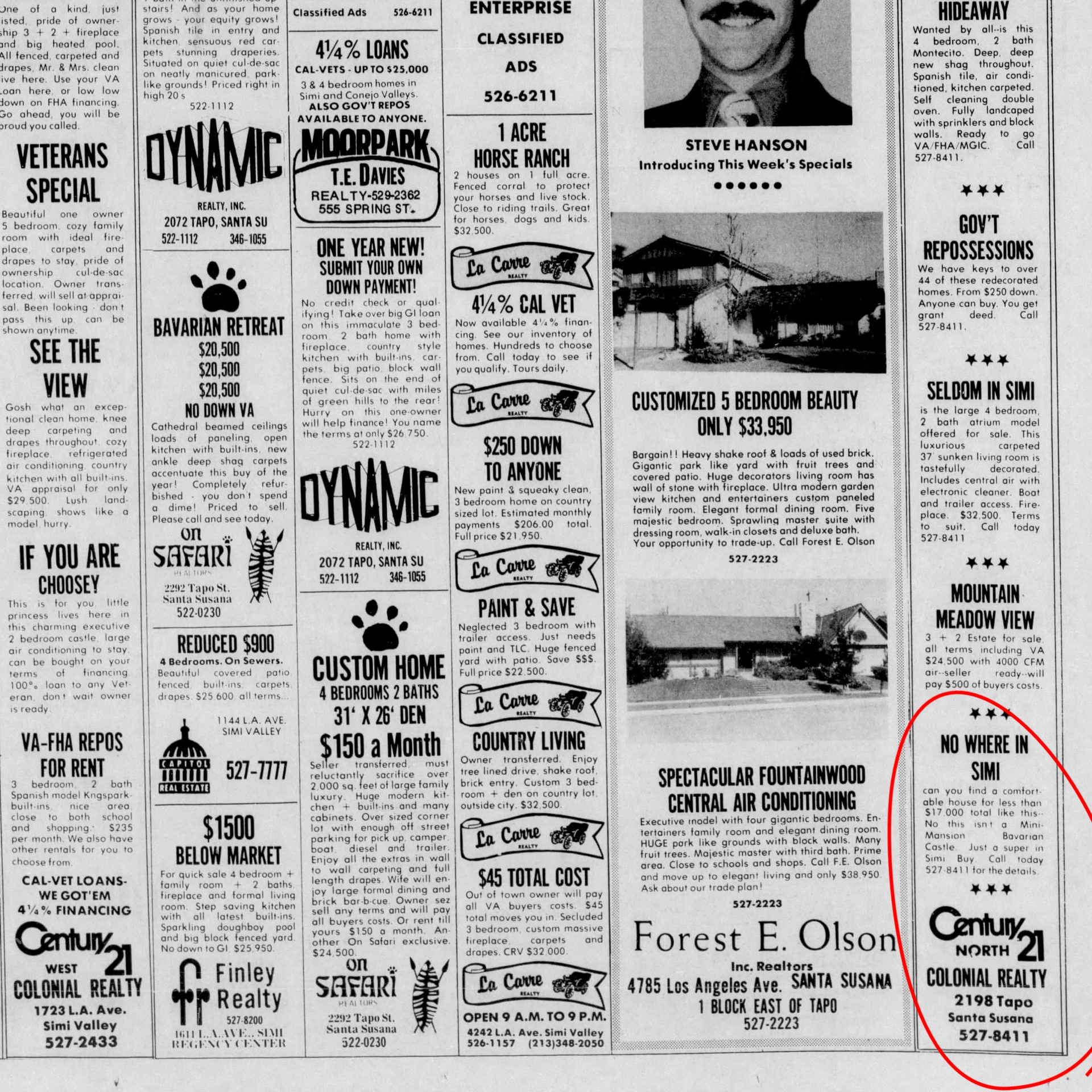
After that article, the castle continued to appear in public records — not as folklore, but as real estate.
- January 1973: Colonial Realty Century 21 advertised it for sale.
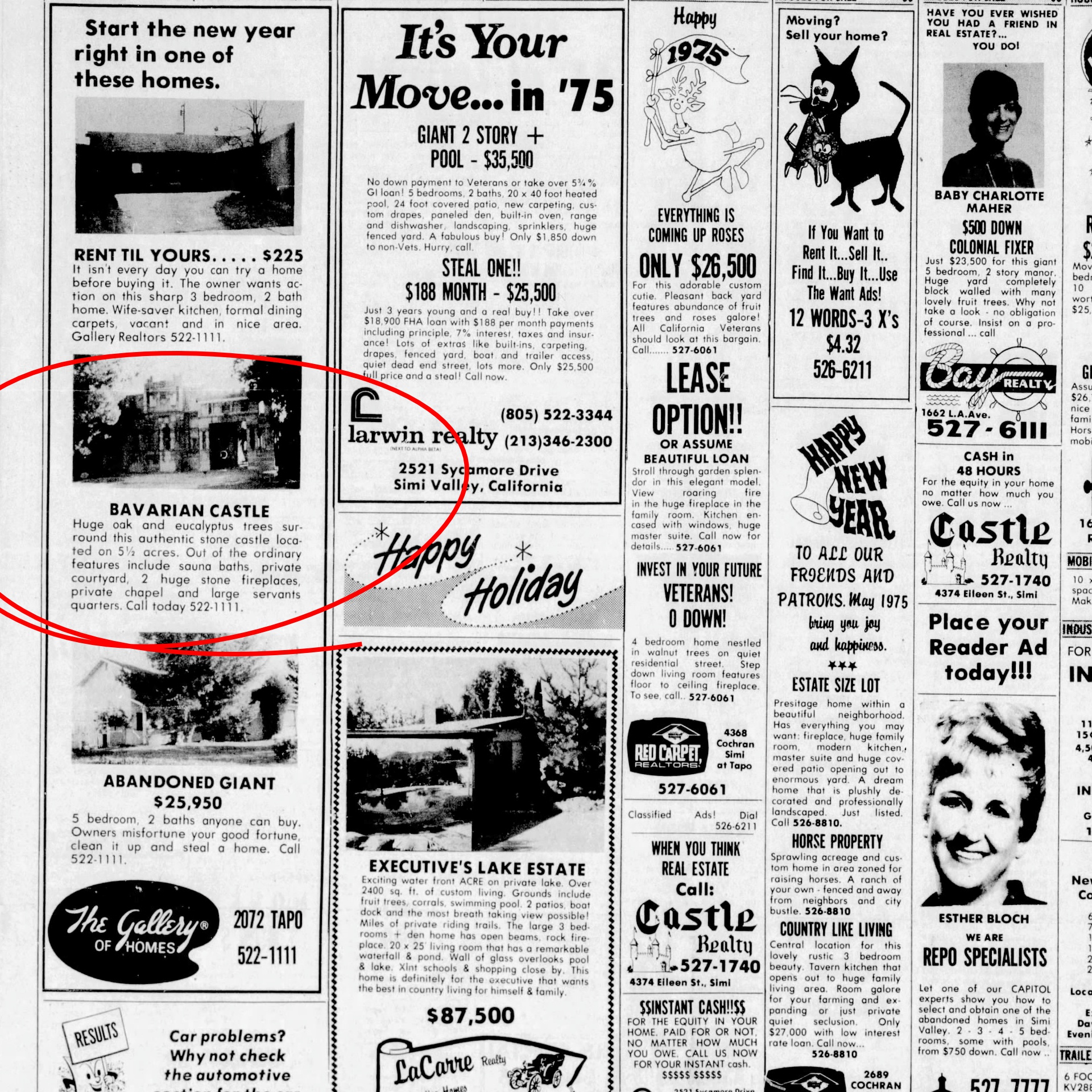
- 1974: Gallery of Homes listed it again.
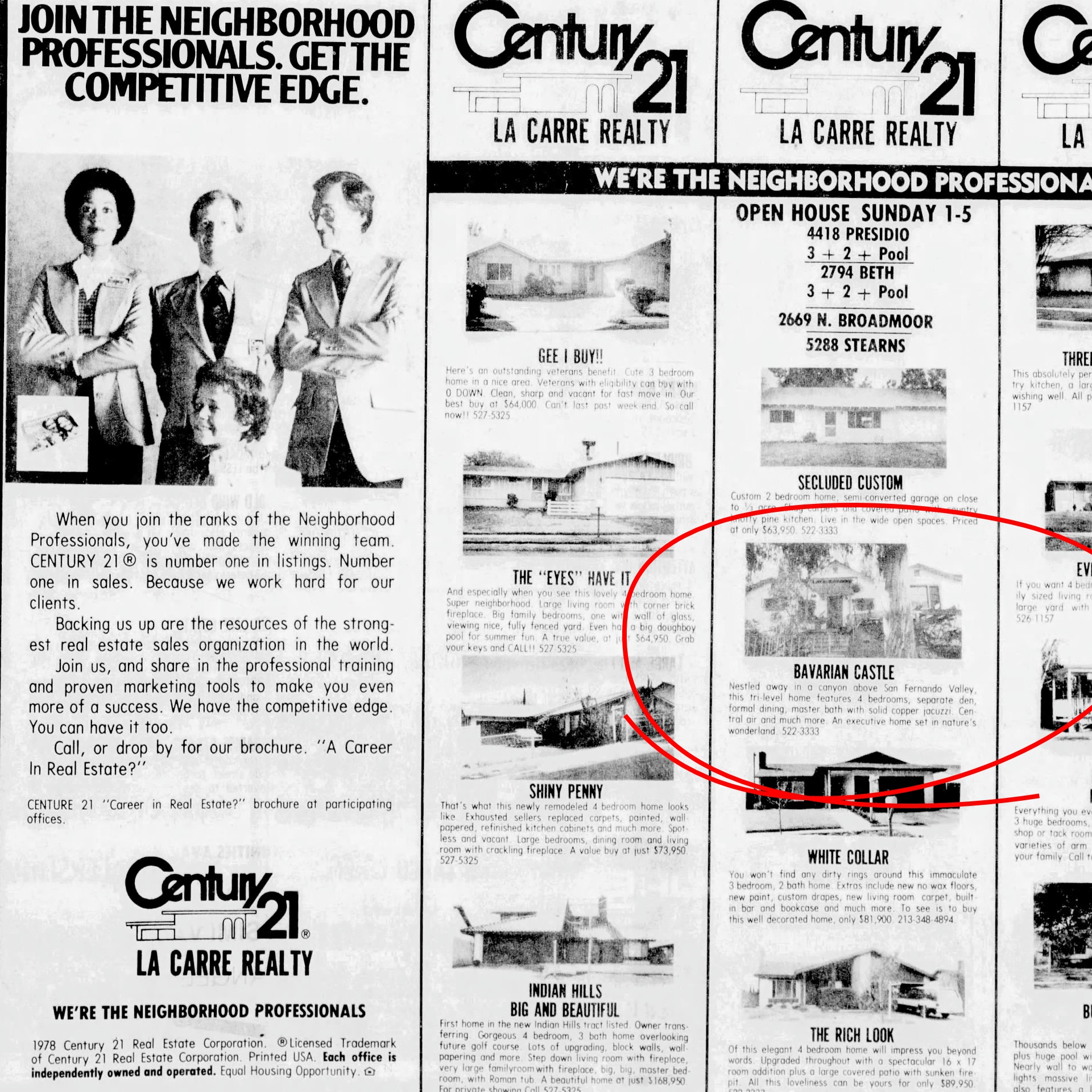
- 1978: Century 21 offered it one final time.
Each listing carried the same address — 4986 Cochran Street — confirming the building still existed nearly forty years after it was built.
Then, abruptly, the record ends.
No follow-up articles. No mention in the paper. No transfer of ownership recorded publicly. The property disappears from listings and archives alike.
By the early 1980s, the land had been redeveloped. Whatever remained of Ulmer’s Castle — its stone walls, its timber beams, the trees that once framed it — was gone.
The Record That Isn’t There
No one filed for demolition. No preservationist petitioned to protect it. The Ventura County Cultural Heritage Board, which tracks every designated historic site in the region, lists nothing at all at 4986 Cochran Street.
And yet, ordinary people have not forgotten. Local residents continue to leave notes online, referencing “Ulmer’s Castle.” On Google Maps, someone even tagged the location as a “Historic Landmark.” The irony is painful: the internet remembers what official history does not.
The 1970 Enterprise article made clear that the Church of Jesus Christ of Latter-day Saints had purchased part of the Ulmer property. That church’s archives are known to keep precise land and building records. If any organization holds photographs or surveys of the adjacent castle before redevelopment, it may be the LDS Church itself. But no such documents have surfaced publicly.
The county, for its part, offers no explanation.
What We Know
– Builder: Lt. John Tury Ulmer, Munich-born former Prussian officer.
– Year built: 1939.
– Address: 4986 Cochran Street, Simi Valley.
– Lot size: Five acres.
– Builder’s death: Circa 1969.
Listings:
- 1970 (Wendell Irwin)
- 1973 (Colonial Realty Century 21)
- 1974 (Gallery of Homes)
- 1978 (Century 21)
– Neighboring development: LDS Church purchased adjoining land, 1970.
– Disappearance: No trace in county or heritage records after 1978.
The Questions Left Behind
Why was a castle that once stood plainly beside one of Simi Valley’s busiest roads erased so completely from official history? How could a structure featured in the newspaper, photographed, and advertised by national real estate firms leave no paper trail of its end?
Did it fall to neglect, dismantled stone by stone as new development moved in?
Was it demolished quietly, its materials salvaged, its absence unrecorded?
Or did it survive longer than anyone realizes — its story buried under new foundations and new names?
The silence around Ulmer’s Castle is puzzling.
For a city that prides itself on remembering its past, this omission stands out like an empty lot on the map.
What It Meant — and What It Means Now
Ulmer’s Castle was more than a curiosity. It was a work of devotion — the physical proof of one man’s will to rebuild his life after war. It stood as a reminder that history doesn’t just happen elsewhere. It happens here, in the hands of people who carry their stories into new soil.
Today, the site looks ordinary. But history isn’t erased by construction; it’s only hidden. Somewhere beneath the streets and lawns of modern Simi Valley lie the stones of a vanished dream — a Bavarian castle built by an exile who never stopped building.
And somewhere in the valley’s collective memory, the question still echoes:
How does a castle disappear?