
 Sylvie Belmond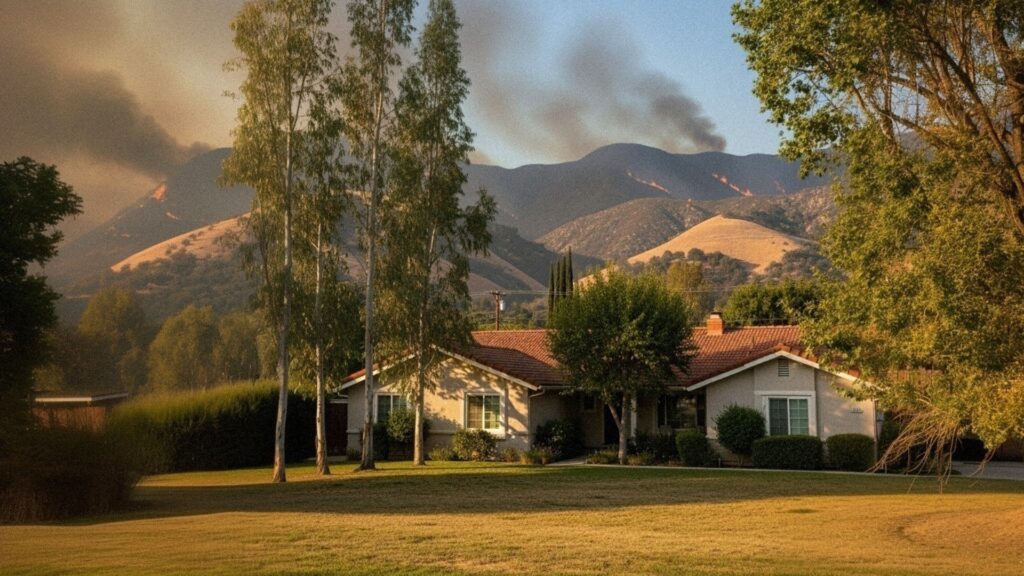
Clearing Zone 0 is just the start — insurance rates climb as fire danger grows
(CLAIR | Simi Valley, CA) — When a Simi Valley homeowner opened an HOA letter, their heart sank. The trees that kept their wall cool all summer had to be cut down. Soon after, neighbors across town and in nearby communities logged on to Nextdoor to vent. In Upper North Ranch, one called eucalyptus trees both beautiful and dangerous, “like torches when fire season hits.” In Hidden Canyon, another admitted they gave up trying to make sense of the fire codes. In Three Springs, a resident passed a county inspection only to have their insurance company demand even stricter cuts.
Across Oak Park and Agoura Hills, the message was the same: people value their shade but fear the flames. And many say the rules don’t feel consistent or fair.
As fire season intensifies, officials say homeowners should already be prepared before the winds pick up, but if they haven’t acted yet, there is still time to make changes that protect their homes.
The five-foot rule in plain terms
At the heart of the debate is what’s been dubbed the five-foot rule. Cal Fire says the first few feet next to your house — what they call “Zone 0” — are where embers often land. That area must be clear: no mulch, no shrubs, no wood near walls or decks. Instead, use gravel, pavers or plain dirt as a buffer (Cal Fire, Defensible Space).
Ventura County’s fire department went a step further. As of March 1, 2025, new buildings or additions must keep that same strip entirely free of plants or wood. No vines on walls, no tree canopies hanging over roofs, and no wooden fencing attached to the house (Ventura County Fire Department, Standard 515). And when a home sells in a high-risk zone, state law now requires proof of defensible space or a written agreement that the buyer will bring the property into compliance within a year (Ventura County Fire Department, AB 38).
Hardening homes, not just yards
Clearing plants is only part of the story. Cal Fire says keeping embers out of the house itself is just as important. That means upgrading vent covers to ember-resistant metal, cleaning gutters and using metal covers, adding drip edges under roof trim, and replacing old windows with double-pane units that include at least one tempered glass panel (Cal Fire, Home Hardening).
Researchers at UC Santa Barbara and San Diego State said well-watered, healthy plants can sometimes slow fire by holding moisture, but unmanaged shrubs under windows or along fences can ignite in seconds. They cautioned against rules that treat all plants as equal fuel and argued that features like vents and gutter covers may play a bigger role in saving homes than blanket removal of landscaping (The Conversation, June 2, 2025).
Insurance costs hitting the ceiling
Even after clearing defensible space and sealing homes against embers, many residents are now fighting a financial battle. State Farm requested a 17% increase for homeowners across California to help cover wildfire losses, according to CalMatters (May 13, 2025). Allstate received approval for an average 34% hike, with some homeowners seeing increases of 100% or more, the Washington Post reported. And from 2021 to 2024, average premiums nationwide rose 24%, or about $600 more a year, according to the Union of Concerned Scientists.
In Agoura Hills, one HOA now charges a $250 monthly special assessment just to pay for fire insurance. It used to be included in the regular $475 monthly bill, but now residents are paying $725 a month — and the number is not expected to go down anytime soon.
For those who lose coverage altogether, the fallback is the California FAIR Plan, the state’s insurer of last resort. The California Department of Insurance says FAIR Plan provides only basic fire and smoke coverage and excludes liability, theft and water damage, which means homeowners often must buy a second policy to cover the gaps.
The trade-off we face
Residents aren’t wrong about what trees give us: shade that softens the heat of summer. They’re also not wrong about the risk. Firefighters say the first five feet around a house is the frontline — the spot where embers decide whether a home survives or burns.
In Simi Valley and across Ventura County, the real question isn’t trees or safety. It’s how to plant wisely, prune carefully and clear space with purpose. The shade we lose today may be the reason our homes stand tomorrow.