
17 Things You Didn’t Know About Simi Valley Traffic and Who Is Really Controlling It
 Daniel Jordan
(CLAIR | Simi Valley, CA) — Simi Valley drivers move fast. Morning drop-offs, late commutes, weekend errands — everyone’s trying to shave a minute off the drive. And it shows. Most of the city’s serious crashes come down to one thing: aggressive driving!
But traffic in Simi Valley isn’t just about frustration. It’s a daily test of how design, behavior, and community all fit together. Behind every green light and striped lane is a small team of engineers quietly shaping the way 120,000 people move. They study crashes, time signals, answer calls, and turn public complaints into safer intersections.

City traffic engineer Justin Link has spent seven years watching how this city flows — where drivers rush, where they hesitate, where they break the rules. What he’s learned says as much about people as pavement.
Here are 17 things you probably didn’t know about Simi Valley traffic — and the team working every day to keep the city moving forward.
1. Aggressive driving causes most local crashes.
The city’s Local Road Safety Plan looked at hundreds of collisions and found one consistent pattern — impatience. Speeding, tailgating, rolling through red lights, or trying to beat the yellow all top the list. Link calls it “behavior, not geometry.” These aren’t dangerous roads; they’re roads used dangerously. The city’s data-driven fixes now focus less on adding signals and more on shaping driver behavior before it turns risky.
2. Engineers use “social design” to calm drivers.
The city can’t post a police officer at every intersection — so it redesigns the street instead. Small visual cues make drivers subconsciously slow down. Narrower lanes, longer medians, or fresh white lines create the sense of a tighter road. When Royal Avenue was restriped near Volunteer Park, speeds dropped almost instantly — no speed bumps, no tickets, just better design.
3. Speed limits aren’t political — they’re mathematical.
If you’ve ever wondered why that 45 mph sign sits where it does, the answer is math, not mood. California law requires cities to set speed limits using radar surveys and the “85th percentile rule.” That means engineers find the speed 85% of drivers already travel safely — then post that number. Set it lower, and the ticket won’t hold up in court. It’s how cities keep limits fair, enforceable, and data-driven.
4. Residents sometimes paint red curbs themselves — and it’s illegal.
Frustrated residents sometimes grab a brush to paint red in front of mailboxes or driveways, hoping to keep sightlines clear. The intention is good — the result isn’t. Unless a curb is recorded and approved by the city, it’s not enforceable. Police can’t ticket anyone for parking there. “It has to come from us,” Link said. “Otherwise it’s just red paint.”
5. Roundabouts aren’t off the table — just not for every street.
Roundabouts sound modern — but they’re not one-size-fits-all. They only work when traffic flows evenly from all directions. At Kuehner and L.A. Avenue, it might make sense someday. But at Madera and L.A., where 60,000 cars move daily, a roundabout would jam. “It’s not that we don’t like them,” Link said. “They just don’t fit everywhere.” For now, Simi’s engineers are open — but cautious.
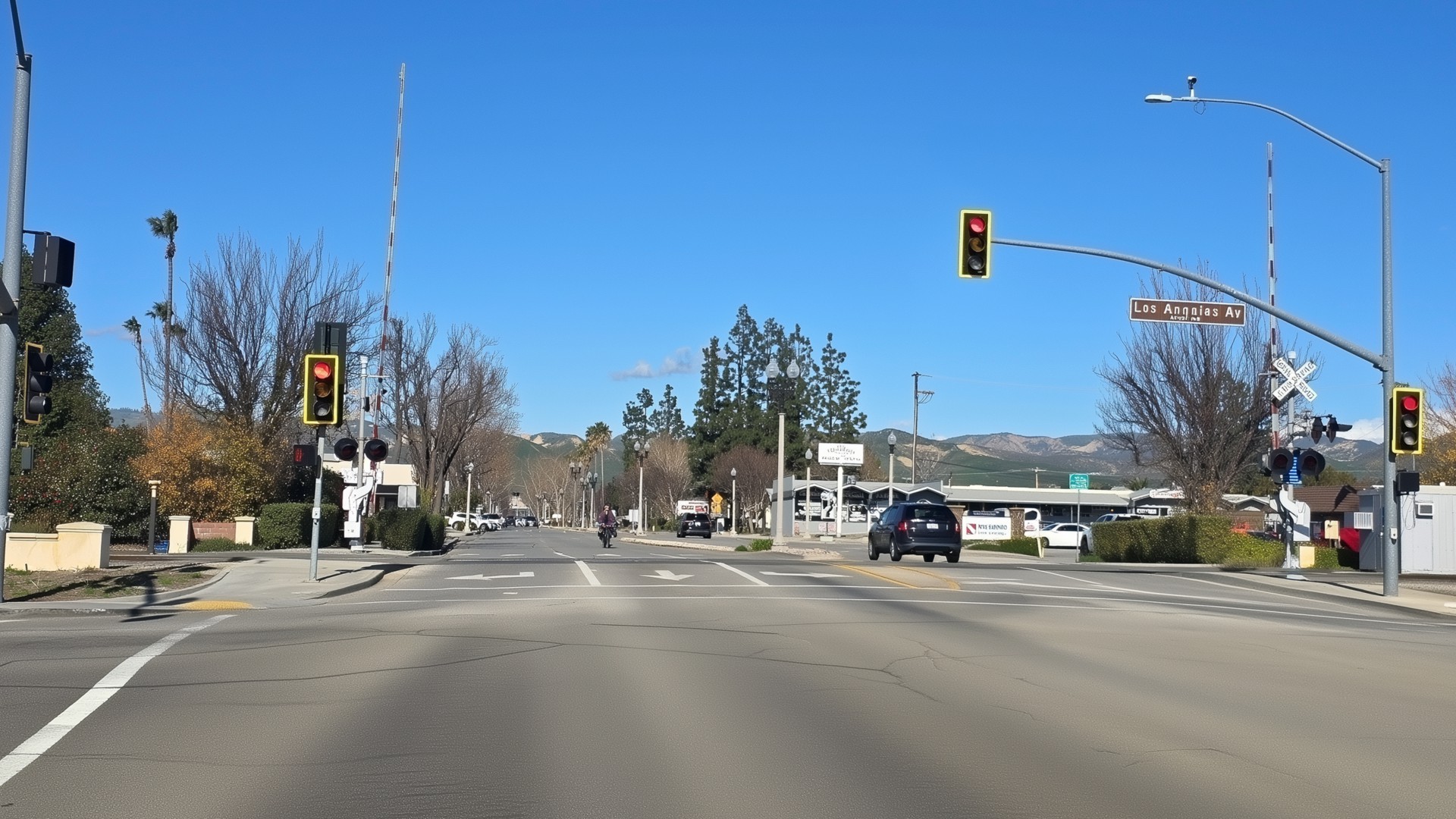
6. Three engineers run the entire operation.
What used to be a seven-person division is now three. They handle everything from signal timing to signage replacement to public Q&A. It’s a small team with a big mission — to keep Simi Valley’s infrastructure safe, modern, and responsive. They’re proof that a city doesn’t need a big staff to make steady progress — just focus and follow-through.
7. It’s illegal to park within 20 feet of a street corner — even if it’s not painted red.
California’s new daylighting law took effect January 1. It bans parking too close to intersections to help drivers and pedestrians see each other sooner. The city doesn’t have the budget to paint every corner, but enforcement doesn’t wait for paint. If you park too close, you can still get a ticket. It’s a small rule with a big safety payoff — clearer views, quicker reactions, fewer collisions.
8. Mail delivery gets caught in the middle.
Some postal carriers refuse to deliver if a car blocks a mailbox — even if it’s just for a few minutes. That’s led to a wave of unofficial red curbs in neighborhoods like Wood Ranch and Mount Sinai, painted by homeowners who just want their mail delivered. But those homemade markings don’t count. Only city-installed curbs are legal. The better solution, Link says, is neighbor-to-neighbor conversation — and a little patience.
9. Simi Valley’s traffic enforcement team is smaller than you think.
For years, the entire city had just one motorcycle officer enforcing traffic laws. Now there are three — a huge improvement, but still not enough for 1,000 miles of city streets. That shortage shapes how the city approaches safety. With limited enforcement, Simi focuses more on education and engineering — the “Three E’s” that guide every traffic decision: Education, Engineering, Enforcement.
10. Speed humps and lane changes start with residents.
Every year, the city fields dozens of requests for new speed humps, crosswalks, or lane adjustments. Engineers study speed counts, crash rates, and school proximity before deciding which ones move forward. High-traffic residential streets near schools often get priority. It’s slow, methodical work — but it ensures each change is justified by real data, not just frustration.
11. The city maintains 121 traffic signals.
Each one is timed, tuned, and maintained by the city’s contractor, Econolite Systems. Crews perform monthly checkups and respond to outages within hours. Signals on Madera Road and Cochran Street are synchronized during rush hours, giving drivers a smoother green wave. If you hit every light just right, that’s not luck — it’s engineering.
12. Streetlights now belong to the city, not Edison.
Simi Valley bought more than 7,000 streetlights from Southern California Edison for about $3 million. The city then switched them to energy-saving LEDs, cutting electricity costs by roughly 75%. Over the next 20 years, that single move could save taxpayers up to $15 million — and give the city direct control over maintenance and brightness.
13. Look for the “SV” tag on poles.
Want to know who owns the light outside your house? Check the tag. “SV” means the city owns it. A tag ending in “E” means it’s still Edison’s. You can report city-owned light outages directly through the Service Finder tool at simivalley.org — no phone call, no wait.
14. Some signal controllers are older than your first computer.
A few intersections still run on hardware installed in the 1990s — basic, boxy computers that keep time and control light sequences. They have one-ten-thousandth the processing power of a smartphone. Replacing them isn’t easy; newer systems require translation from outdated programming. Bit by bit, the city is modernizing — a quiet upgrade you’ll feel long before you see it.
15. Every sign, stripe, and arrow follows state standards.
The California Manual on Uniform Traffic Control Devices dictates everything from the size of a stop sign to the curve of an arrow. Even the exact shade of red is standardized. Simi Valley has about 18,000 signs (17,999 to be exact), each placed and maintained according to those rules. It’s not arbitrary — it’s how engineers make sure every driver, anywhere in California, reads the same message the same way.
16. During power shutoffs, every dark intersection becomes a four-way stop.
When Edison cuts power during high winds or red-flag warnings, signals go dark — and crashes rise. Many drivers simply forget the rule. “It’s a four-way stop,” Link reminded residents. “Always.” It’s a simple act that can prevent dozens of accidents during public safety power shutoffs.
17. The city studies crash patterns every year.
Every January, Simi’s engineers analyze collision maps, reviewing which intersections saw the most incidents and why. They look for clusters — left-turn crashes, rear-end accidents, school-area fender benders. That data decides where to invest state grant money. It’s quiet, technical work that turns spreadsheets into safer intersections.
Why It Matters
Every intersection, every light, every painted line is a promise — that a city is thinking ahead, even in the background. Simi Valley’s traffic story isn’t about congestion. It’s about connection: between design and behavior, between city hall and the street. When that connection works, the whole city moves better — not just faster, but smarter, safer, and more in sync.